
The Room of Light
The Room of Light
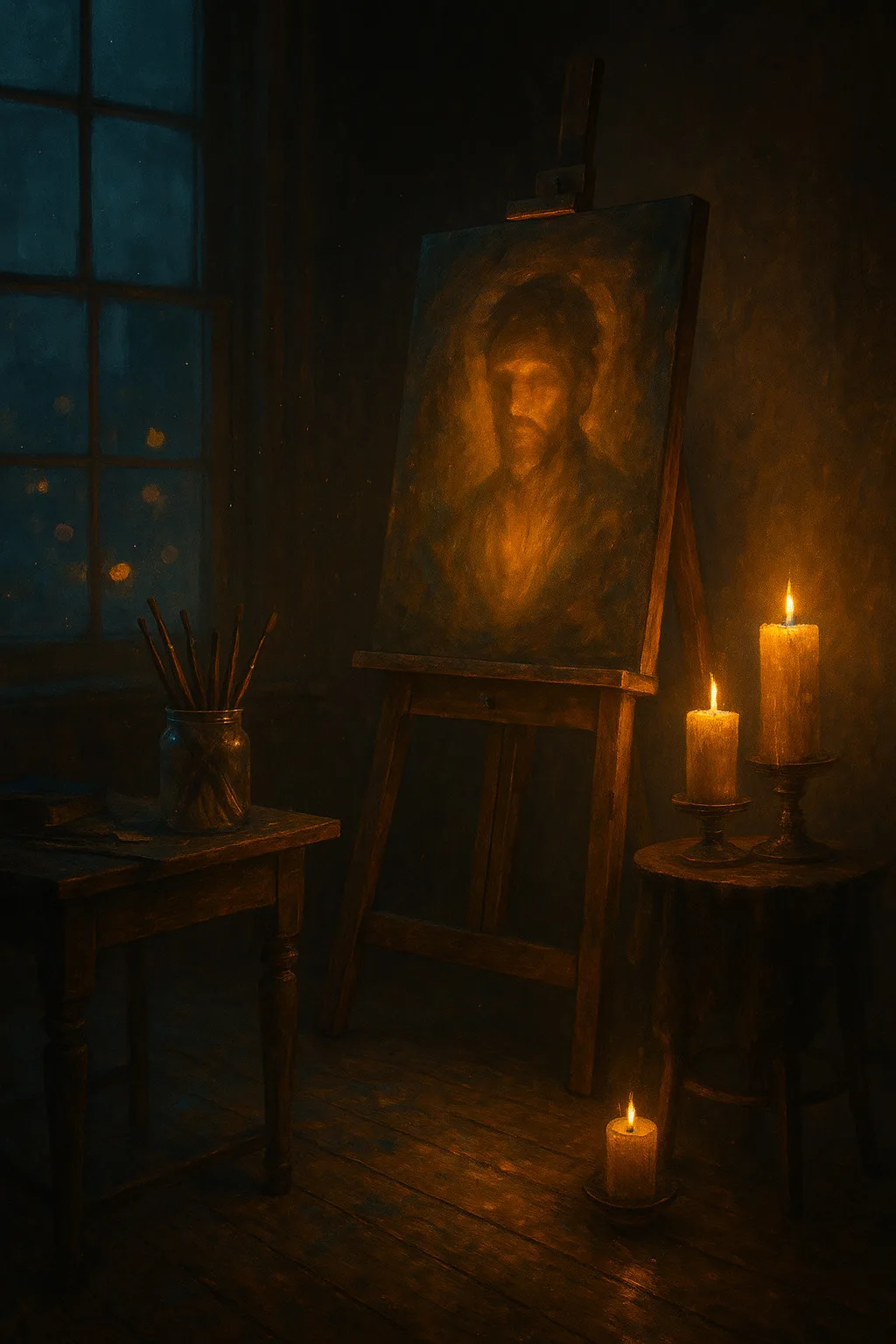
It began with a sound that wasn’t one—more a fine crackle against the skin of the night, as quiet as dust breathing in backlight. Mara stood before the canvas and mixed the light, layer by layer—not as paint, but as memory. White with a drop of honey, a hint of morning sky she plucked from the window. The city lay far below her apartment like a coat someone had set aside, and in other people’s windows burned the stories of those who never climbed up to her.
She had been painting the same stranger for weeks. At first there was only the sense of a gaze, a shadow walking through her mind like a recollection. Then the contours of a face that couldn’t be held and yet lay in her heart like a shell that keeps the ocean. The hands were the hardest. Hands tell everything. She let them rest open in his lap, as if holding something invisible—something you can only feel when you close your eyes.
“Who are you?” she whispered, and the walls listened.
The studio was small, too small for the longing that stood inside it like an extra person. Stacks of books, brushes in a glass, the water shimmering like the thin remainder of a moon that no longer knew which night it belonged to. The wooden floor carried traces of turquoise, ivory, warm sienna—rings of years the way a tree keeps them. On the windowsill lay a dusting of salt from her last visit to the sea. Mara had brought it without knowing why. Perhaps so that something in this room would believe in ebb and tide.
She kept painting until the light behind the window began to change. The city pushed orange flames into the clouds, as if someone had forgotten a second sun. Mara stepped back. The stranger’s eyes looked at her—part sorrow, part astonishment—like someone late to a conversation that had begun without him.
“Not yet,” she said with a narrow smile. “Not yet.”
At night she dreamed of stairways ending in water. And every time he stood there—the stranger from the painting—on the last step, shoes in his hand, as if he didn’t want to dirty the silence. In the morning she rose, ate cold rice with cinnamon, opened the window as if the apartment needed air the way a sick child does, and began again. The room was her body; the canvas, her heart.
On the seventh day—or the thirty-seventh; time had the habit of turning up its collar— the painting began to glow. Not strongly, only as if a secret dawn had gathered at its edges. Mara blinked, set the brush down, lifted it again. There was no electric light to flicker, no reflections that could dance like that. She didn’t touch the canvas. She had sworn to herself: never touch what you don’t understand.
“You’re here,” she said softly, and it wasn’t clear whether she spoke to him or to the night.
The rain came without announcing itself. It ran down the windowpanes like people hurrying through an unfamiliar city, trying not to get wet. Rain has a way of erasing the world’s sounds until what’s inside grows louder. Mara’s heart beat in a rhythm she didn’t know. It wasn’t the beating before an exhibition, nor the beating before a farewell. It was the beating that says: there’s another rhythm you never learned, and yet you remember.
She sat on the floor. The light in the painting shifted, warmer now, as if somewhere in another room a door had opened. The stranger’s eyes seemed deeper. Maybe she had only added one shadow too many. Maybe.
“If you come,” she whispered, “don’t come like a dream. You know what dreams leave me with: hands that are empty and a mouth that tastes of your name, which I never know.”
It was as if the painting answered with a barely audible rustle. A few seconds later a spider dropped from the upper edge of the canvas on an invisible thread, swinging between wall and picture, and Mara had to laugh because even life’s little accidents took the shape of a sign. She stood, lit a candle though it was day. A room sometimes needs fire—not to warm, but to gather what belongs to it.
“All right,” she said. “I’ll set your chair.”
The chair had stood empty for years. Beside the canvas, never used. A piece of furniture that waited, and she never knew for whom. She turned it toward the painting, took the blanket that smelled of lavender, laid it over the back. Then she sat opposite and waited with it.
When the candle was half, the man in the painting—or was it the light?—lifted his gaze a little, just enough for the room to hold its breath differently. Mara heard the drip of the rain, heard her own quiet, heard time listening.
“I invented you,” she said, without believing what she said. “But that’s not the word. I found you, I think. In me. Or outside me. It doesn’t matter.”
She stood and stepped closer. A fine lemon scent hung in the air, as if the brush had last dipped itself into something fresh. Her fingers wanted to touch the canvas, but instead she touched the air in front of it, as if she could stroke an invisible skin.
“Mara,” said someone.
It was a voice that couldn’t have come from outside, because the world outside throws names around carelessly. This voice lifted her name up and handed it back, with a tenderness older than habit. Mara took one breath, heard the wood crackle as if it were kneeling for her.
“You…” she said, and there was an entire book in that word.
He did not step out of the painting. That would have been too easy, too blunt. Instead the room did something: it shifted its walls by half a breath, moved the light to a place where it could carry him, and suddenly he sat in the chair, as if he had always been there and the years had simply chosen the wrong light to show him.
He wasn’t a miracle. Or perhaps he was exactly that, but the kind that doesn’t require questions to be true. His face wore the tiredness of someone who has waited a long time at the edge of something that had no name, because names are too sharp for soft things. His hands—the ones Mara had been unable to catch—rested open in his lap, as if they held the space between the fingers.
“I don’t know how to do this,” Mara said, and had to laugh because it was the same sentence she’d said as a child when learning to ride a bike, right before she managed it.
“You’re doing it,” he said. “You’re sitting here, and I’m sitting here, and the room is made of light.”
“Who are you?”
He lowered his gaze, not out of shame, more to listen to her question. “I am the one you called without calling. I am the picture of me you painted, and I am what was before that. Both are true, and neither injures the other.”
“And why… why now?”
“Because longing is a vessel,” he said. “And you stopped putting it away. Many hide it in the cupboard at night. You set it on the table, day after day, and something fell into it that was more than air.”
Mara felt a warmth rise in her that didn’t begin with the body. “I missed you before I knew you,” she said.
“That’s a kind of memory,” he answered, smiling, and with the smile the rain drew back, as if not wanting to block their view.
They spoke little. Words are laborers, and most love to carry too much. In this room, though, words were guests. They came when called, sat down, ate a slice of quiet, drank a little gaze, and left again. Mara told of the days she had saved with color, of the nights she had mended with light so they wouldn’t tear on fear. He told of paths not on any map, of doors leading to courtyards where no one had ever called and yet someone answered.
Sometimes he was silent, and when he was, Mara heard the sound of the place where his life leaned against hers. It sounded not like music and not like wind—more like a thread pulled through cloth.
“Do you have a name?” she asked at some point, because names are small boats you can use to cross certain waters.
He gave one. It was a simple name. But when Mara repeated it, it sounded different, as if the room translated it into something closer to the truth.
“Will you stay?” she asked, and her voice held nothing but what was there: a plea with open hands.
He looked toward the window. The rain had stopped, but the drops still clung to the glass like notes to be read later. “I’ll stay as long as this room’s light can hold me,” he said. “And perhaps beyond.”
“What if the light goes out?”
“Light has many forms. You know them all.”
They stood, as if that were the movement the room expected. He stepped to the canvas and studied his face. It is a strange intimacy to see yourself like that—not in a mirror, accustomed to the world, but in a gaze that knew you before. He touched the air before the canvas with the same care she had shown.
“You painted me soft,” he said.
“I had no other color,” Mara said.
Days went by when they forgot to wind the clock. They walked the city without taking streets, as if smaller ways were permitted to them. In a café that was never full, he read to her in the corner from a book neither knew, and yet it lowered its voice at the right places. In the evenings they returned to the room of light, and sometimes—sometimes—the edges of reality flickered as if the world wanted to say: I am larger than you believe, and I grant you this niche.
Of course there came the day when fear arrived. Fear has a good memory and finds every room. It didn’t come as a scream but as a small question playing too big: What if he disappears when you close your eyes? What if he’s a guest who already has his shoes on?
Mara didn’t ask the question of him, but of the canvas. She took the brush and drew a stroke—barely visible—at the collar of his shirt. It wasn’t a mark of ownership, no tether. It was a knot, the kind sailors tie when they know waves are coming.
“I’m not made of flight,” he said, as if he had heard her brushstroke.
“I know,” she said, and her hands were steady.
One evening—the sky violet, as if someone had reached into the paint pot and then wiped their fingers on the clouds—he brought a question he didn’t ask at once. It lay between them on the table where bread usually lay. He looked at her, Mara looked back, and what happened next was as simple as a door opening.
“Will you stay with me when the room changes its shape?” he asked. “When we no longer know whether the world is ours or whether we are the world?”
She thought of the bridges of her childhood, of the stairways of her dreams, of the grains of salt on the windowsill, of everything that might have been a sign or simply the beauty of a random arrangement. Then she nodded, and her nod wasn’t a decision but a remembering: I said yes long before there were words.
They went to the window. The drops were gone, but in their place something else stuck there: tiny crumbs of light, as if the day had snagged on the glass. He placed his hand beside hers on the pane. The glass grew warm. Outside, the city began to quiet, and a wind rose that walked not through the streets but through the years.
“If we go,” he said, “we won’t need to close the door. The room will remain for others who need light, the way you did. And if we stay, we will still go— in the way that makes a place larger.”
“And love?” Mara asked. She asked because love wants to be asked, not because she doubted.
“Love,” he said, “isn’t a guest. It’s what sets the chairs.”
They stayed. They went. They did both, the way you breathe in and breathe out without losing the world. On some days the room had two chairs, on others four, as if friends were coming they did not yet know. Sometimes the canvas glowed faintly at night, a remembrance of a time when light was the only bridge. And when Mara reached out, she met his hand. Not because the world is a miracle you can hold, but because two people decided to live a miracle instead.
Later—much later—someone found the drawings in a drawer: small studies of hands holding something invisible. On the back of one sheet, in Mara’s handwriting, it said: “I paint you soft because everything hard already has enough names. And I love you so that the world grows around it.” The one who found it smiled for no reason, and perhaps that was reason enough.
For somewhere, between the windows where other people’s stories burned and the sea salt on an old sill, there still stood a room of light. You couldn’t rent it, couldn’t buy it, couldn’t lose it. You could only enter if you carried the right name—and sometimes “I am here” was enough.
And if you then asked, “Who sets the chairs?” the quiet answered: “Love.”