
The Roots of Time
The Roots of Time
The night smelled of damp earth and old paper when Elias pushed open the gate of the abandoned research station. The sign—“Institute for Ethnobotany, Field Unit 3”—hung crooked in its frame; the rain had washed the letters so long they looked like blurred memories. He set down his bag, wiped droplets from his notebook, and listened to the sorrowful dripping of a gutter that emptied somewhere into a shape of moss and stone.
He hadn’t come for the buildings, nor the rusted instruments. He had come because the reports from the village down in the valley kept repeating like a refrain: someone had found a plant that knew things. The elders called it the Root Ring—some said Memory Root. One man had told him, with the cautious seriousness of someone afraid to name the moon, that it remembered faces.
Elias was a botanist. And though he had learned to separate—names from feelings, specimens from stories—he was also the grandson of a woman who had told him, when he was a child, about plants that did not eat people but bound them. “Some plants have no mouths,” she had said, “so they speak with what we leave in the soil.” Hair, blood, tears. It had sounded like a fairy tale until the river swallowed their village and the survivors fled uphill, and those who returned later swore they had heard their dead speaking in the drowned garden.
The station lay at the edge of the floodplain, in a cool hollow where at night the fog hung among the shrubs like the breath of a sleeping animal. The greenhouse, a humped shell of glass and iron ribs, held a faint glow—not electricity, which had been cut years ago, but something like the light that lingers on old wood when you’ve stroked it too long. Elias slid the door open. It groaned, as if the memory itself resisted.
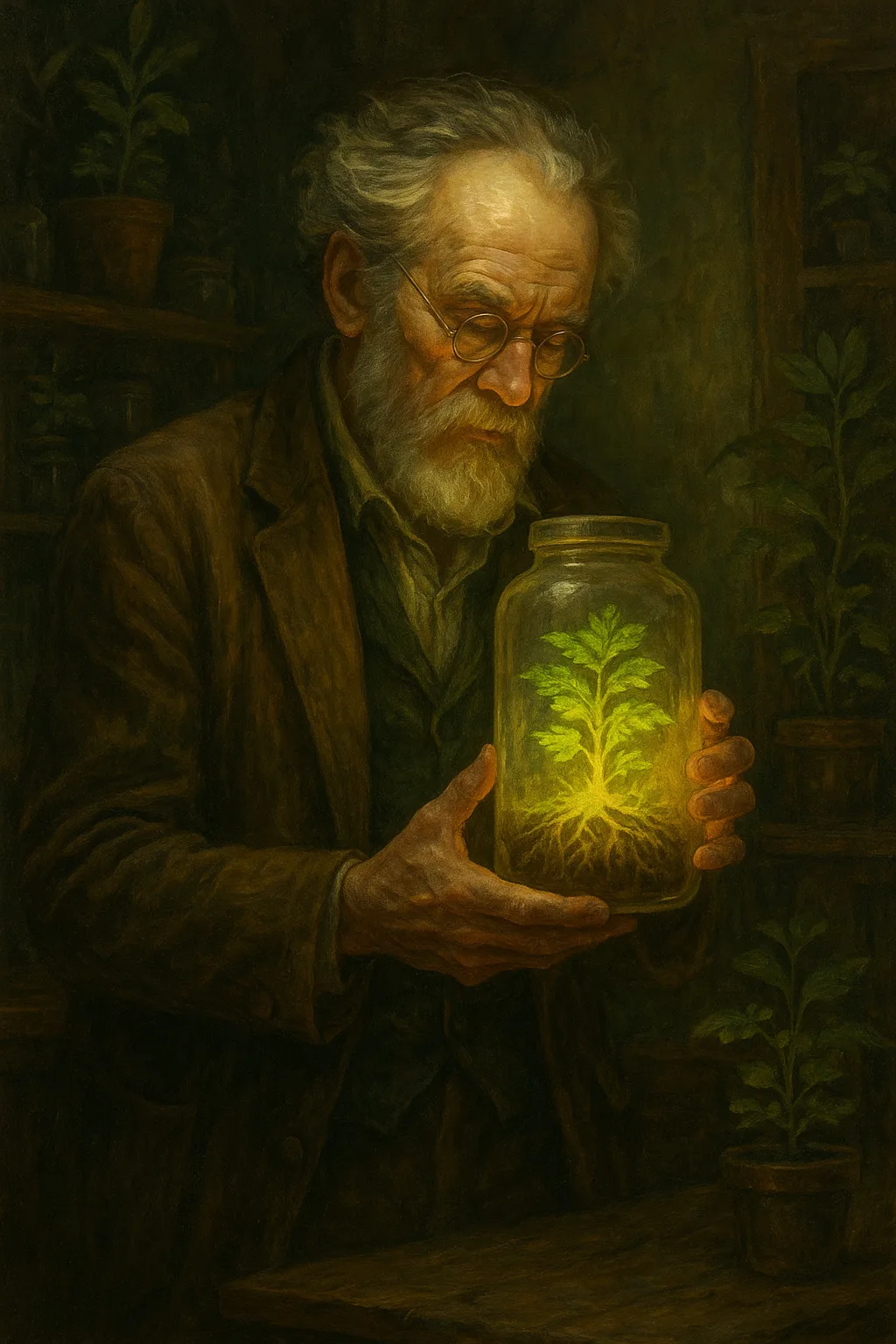
The scent inside was different. Not the clean, vegetal smell of domesticated plants, but something mineral, slightly bitter, and so gently sweet that his mouth watered. In one of the beds, between escaped philodendrons and the brittle skeleton of a coffee plant, it grew: no tree, no shrub, more like a vine whose segments clasped together like fleshy chain links. Its leaves were thin as the skin over the back of a hand, and within their delicacy ran fine veins, as if someone had drawn maps across them.
He knelt. The root—he brushed the top layer free with a spatula—didn’t go deep but spread wide, a network of rings nested inside one another like the growth rings not of a tree but of a place. When he set the blade, the plant didn’t resist; it opened as if pleased. From the cut welled a drop, clear as tears yet full of dusty colors in the light. He readied a pipette, drew a few microliters into a vial, labeled it. The drop left on the knife shimmered like a last thought.
He could have wiped it away, cleaned the blade, gone back to his instruments. Instead, he smelled it. The scent lifted images in him the way wind lifts a blanket: children’s fingers crushing clay; a man’s voice laughing and then breaking; the panting warmth of a dog on a hot day. Elias blinked. The drop trembled. Before he could think—he would later realize that most decisions that change a life are not thoughts but a kind of sinking—the drop brushed his lip. Bitter, grainy, a hint of salt. He swallowed.
The greenhouse stayed what it was: glass, shadow, dripping. And yet something stepped closer. Not a sound—more like a shift in space, as though two transparencies had been overlaid and now both were visible. Elias stood, and when his gaze passed the coffee plant, it was suddenly green, full of blossoms, and someone beside him laughed. “Stop, Elias, you’ll pick them too early.” The voice was young, warm, with that tone that makes affection sound impatient. He turned. The greenhouse was empty. But where the voice had hung in the air, the shadow wavered, as if someone had passed through it.
He forced himself into a test: opened the vial, checked conductivity, viscosity, fluorescence under UV. What he saw was ordinary and impossible—tiny structures reminiscent of dendritic networks, not cells but patterns, as though the secretion had remembered something and written it down in microscopic lace. He photographed them, noted: “possibly stores chemical patterns of the environment…” He stopped. The word environment was cowardice. What it stored was: someone.
Elias drew up a stool, sat, poured a little water from his field bottle into a beaker, added a few microliters of the sap, stirred. The scent was no longer merely bitter—it was full of voices.
He remembered the night the river took the village. Not all of it—just enough to mark a border. His father had gone out because the water grew louder, and never came back. No one found him. His grandmother had sat by the window, softly reciting the names of the living so they wouldn’t have to bear the weight of the dead. Later, Elias learned names for what cannot be known: chance, fate, hydrological models. None of them warmed.
He drank the mixture. Just a sip. It was as if a door opened, leading not into one room but into many that existed at once. He saw the village at dusk, the shops open, women scolding over wet laundry, children splashing in puddles. He stood in his child’s body, barefoot on warm tiles in his grandmother’s kitchen, smelling bread. And at the same time he sat in the greenhouse, felt the cold metal of the chair. His heart beat, and another, slower heart answered—one that had stopped long ago. “Get me out of the river,” thought a memory that wasn’t his.
The hours that followed broke into layers. Elias wandered—through the greenhouse, through the village, through what the village had been. He laid a hand on an iron beam, and it felt like the stair knob in the blacksmith’s house; he looked through the glass and saw not night but a high summer noon, insects dancing like golden dust. Sometimes people moved within these layers: a woman with a rice hat and a laugh that teased the air; a boy drawing chalk lines; an old man bowed by carrying. They didn’t see Elias. Or maybe they did—and mistook him for a dream.
When the effect faded, morning was gray, and fog stood among the bushes like a silent congregation. Elias’s hands trembled. In his mouth lingered the taste of metal and something like poppy. He wrote. He wrote for half the day. Names, images, sentences. The sentences wanted to rhyme, as if what was told wished to close itself.
He returned the second night. And the third. He varied the concentration. Tried to guide the origin of the visions—his grandmother, his father, the flood. It was like feeding the plant questions, and receiving answers that broke off at the edges. He drank, and sometimes a stranger’s hand lifted his own; sometimes a stranger’s fatigue settled in his knees. He was a botanist. He knew what dependency was—chemically, structurally; he could name the receptors. Yet he laid theory aside like a coat on a summer morning. He wanted to smell again the night when his father still had a voice.
The fourth night brought something else. He had drunk too much—impatient, maybe angry. The layers grated together, no longer gentle overlap but compulsion. He saw his grandmother sitting at a table sorting nails. At the same time, he heard the greenhouse roof groan under storm and his own breath fog the glass door. Then a figure stepped between the rows, paused, and for the first time someone looked at him. Not through him—not as though a memory had been placed in an aquarium—but truly saw him. The figure lifted its head, blinked, and in that small movement there was all the syntax of youth: a boy, narrow-shouldered, grown too tall too fast, hair clinging to his brow. “Elias?” the figure said. Whether it was a word or only the memory of one, Elias didn’t know. He could only nod. His throat was tight. The figure smiled—barely, as if holding something back—then lifted his hand, opened his mouth, and spat water onto the floor. “Too late,” he said. “But maybe not in vain.”
When Elias came to, he was lying on the tiles, cheek cold. The beaker had tipped, liquid soaking into a crescent of dust. A few days later he might have destroyed his notes, ashamed of the science he’d betrayed. Instead, he wrote more precisely. He wrote that the vine spread wider—toward the village. He thought of his grandmother’s words about plants without mouths that speak with what we leave in the soil. The village wasn’t there anymore. But the earth was. The flood had shaken it, stretched it, rearranged it. This plant—however it had arrived, smuggled, carried, born from a seed stuck to a boot—had rooted itself in a slab of memory.
Elias decided to follow the root. Carefully, like an archaeologist, he lifted the topsoil, tracing the rings leading toward the hollow where the main street once lay. He worked for days, ate little, drank from his field bottle, whose metal still tasted of the plant even when empty. Sometimes images seeped through his fingers: a couple finishing a quarrel the flood had interrupted; a child asking questions never born. He learned to close his hand when the past tried to slip inside. He told himself he wasn’t there to lose himself. He was there to find.
The root led him to the greenhouse edge, under a loosened rim, down into wet soil beside the wall. There, in a basin of mud, something seeped—not a brook, just an emergence. The water shone milky, and on its surface floated thin films like the skins of dreams shed too soon. He scooped a little into a test tube. It sounded like seconds dripping in.
He knew that if he went farther, he wouldn’t return as a botanist. He also knew no one forced him. But he had come to understand that some questions live inside you like splinters—you either cut them out or turn them into heartbeat. He chose the heartbeat.
He drank. Not much. Enough for the world to tilt, the way a plate tilts when you touch it and it begins to balance in the air. First came the river—dark, full of things without names. Then his father’s hand, broad and certain on his head. Then the crack of a falling branch, sounding like a shot. The layers shifted. He stood at the bank, rain in his eyes, and the current tore edges from houses, took beams, dogs’ barking, voices. A man jumped—his father—because somewhere someone called. Not him. Someone. He saw the current drag him under the grate at the old weir, saw him surface once more, laughing—yes, laughing; Elias realized he had never remembered that—and then gone. The memory did what memories do: it left the ending out, kept the gesture.
Elias knelt in the mud. He wept—not the kind that asks for comfort, but the kind that washes. It rinsed his face, and strangely he smelled his grandmother. “Too late,” came the voice from the fourth night, “but maybe not in vain.”
He began cutting the rings—not damaging them, but marking them. Thin slices from the outer, silent layers, placed in Petri dishes, examined for pattern. Some rings were empty, like hibernating animals; others so full they sang beneath the microscope. He sketched a map. He called it the Garden of Time.
And then, one day, an old man knocked at the station door. He found Elias among earth and glass—a figure fit for a fairy tale: dirty hands, clear eyes. “I heard,” the man said, “that here one can drink and remember.” Elias nodded, hesitated, nodded again. He led the man into the greenhouse, washed a small bowl, filled it with water, added a drop. “What do you wish to remember?” The man cupped the bowl like a living thing. “My wife,” he said. The air held its breath. He drank. Closed his eyes. Smiled. His shoulders sank. He did not cry. When he left, he placed a dried flower on the bed where the vine lay. “For the garden,” he said. “So it won’t starve.”
Word spread. The station gained visitors—not many, never enough for noise. Elias chose the concentrations. He chose the rings. He had to learn to say no when someone wanted the impossible—the return of the lost, the undone undone. He could only show them what was. Sometimes that was enough. Sometimes it was too much. He began to write rules—not on paper, but in his own body: never drink more than once a week; never the same memory twice; never sit alone at the seep when the fog gathers under glass.
One evening, a girl came. She had the shoulders of a deer and the wary eyes of a creature that had learned to cross city streets. “I want to know how my father laughed,” she said. “I was three.” Elias nodded. He thought of his own father, of the broken laugh the plant had shown him—not as an ending, but as a middle. He chose for the girl a ring formed in summer, when the village slept in the afternoons. He dropped, stirred, passed her the bowl. She drank. She looked up. She laughed. For a moment she seemed to hold something she’d never had before, briefly, in her hand. Then it was gone. She thanked him and backed toward the door, as if afraid a shadow might fall if she turned.
So Elias became the gardener of a memory that wasn’t his. And his own? It was no longer the same landscape. The borders between his life and others’ had shifted. There were days when he smelled coffee blossoms and knew the memory wasn’t his. Nights when his father stood in the glass’s reflection and nodded. He began to speak to him—not in pleas, but in sentences a son says to a father who stays because you set out a chair and a bowl of water.
In one of the first autumn storms, a branch broke from the tree before the station and shattered a pane. The wind burst in, scattering labels, overturning a beaker. The vine shivered. Elias repaired the glass in the fading light, hands that did little else beyond this place. As he tightened the last screw, he felt a sting in his palm. A glass splinter had pierced the skin. A drop of blood fell into the soil, into a crack between two rings. The plant drew in—barely perceptible, more inhalation than pull. Elias watched his blood soak in, thought of his grandmother’s words about plants without mouths, and laughed softly. “All right,” he said. “Take it. Just a little note.”
That night he didn’t drink. He sat among the pots, listened to the rain beginning again, and breathed with the plant. He thought of boundaries, the ones that must be kept—not as walls, but as riverbanks tended so the river won’t take everything. He knew one day he would either go or stay. Both were hard. In the distance he heard the valley road, a car perhaps, winding through curves where the lost sometimes hang like memories from lampposts.
When morning came, he stepped outside. The valley lay under a veil of mist. He waited until the sun thinned it, revealing the outlines of the village reborn under the green of newcomers: willows the river had planted like apologies. Elias raised his hand, as if greeting someone—and there was no one. Or many. He returned to the greenhouse. The vine lay there, glowing without giving light.
Later, when the years turned the station into a place where people stopped because something in them stopped too, a sign hung on the door: “Zeitgarten — Eintritt leise”. People brought bread, yellow flowers, an old clock whose ticking the plant seemed to like. Children ran across the tiles, leaving pale trails of chalk. Elias sat sometimes at the table and wrote—not scientifically, not poetically, but like someone who loves labels because they don’t pin things down, only make them visible with a thread in a dense weave.
They said in the village there was a man up there who drank time. That wasn’t quite true. Elias had only learned to lay it on his tongue, to taste it, to tell bitter from sweet, to know what can be held and what passes through you and still remains—like the smell of rain on a dress left overnight on the back of a chair.
One late evening, when the light at the edge of the forest burned without fire, he went into the greenhouse, leaned over the plant, and laid his hand on one of the inner rings. He could have labeled it: “Father.” He didn’t. Instead, he whispered, as one does to a sleeper, “I’m going for a walk now.” He hadn’t drunk in a long time. He was no longer hungry for it. Not like that. The plant was warm beneath his hand, as though it had blood. Maybe it did. Maybe some of it was his. He set a bowl before it, filled it with water—no drop this time—just so it would be beautiful to have something near you that you love. Then he turned off the light.
Outside, the river was still river. Inside, time was still time. And somewhere between them—in the root, in the rain, in what people give each other without dying from it—something grew that one could call hope, if one liked the word. Or simply: a plant.